Hydraulic breaker selection depends on the excavator, the material, and how the attachment will be used—not the largest hammer in a catalog. A breaker that looks powerful on paper can still deliver poor production if its carrier is unstable, its oil flow is outside the required range, or its tool is wrong for the material.
The best match is a complete system: carrier, auxiliary hydraulic circuit, breaker body, mounting bracket, working tool, hoses, and service plan. A disciplined hydraulic breaker selection method evaluates that system before comparing price. This guide explains the nine checks that contractors, quarry operators, rental fleets, and equipment distributors should complete before requesting a final quotation or reviewing the complete ARTUS hydraulic breaker range.
Quick answer: Choose a hydraulic breaker by matching the manufacturer-approved carrier range, total installed weight, oil flow, working pressure, return-line requirements, tool diameter, housing type, application, and local parts support. This hydraulic breaker selection checklist must go beyond excavator tonnage. Confirm the actual machine configuration and hydraulic readings before installation.
1. Start Hydraulic Breaker Selection With the Job
Every good hydraulic breaker selection starts with a clear description of the work. “Breaking rock” is not enough. Primary breaking on an intact quarry face creates a different load from reducing blasted boulders beside a crusher. Removing a reinforced foundation is different from lifting thin asphalt during road repair.
Define these conditions first:
- Material: asphalt, plain concrete, reinforced concrete, limestone, granite, frozen ground, or another material
- Task: primary breaking, secondary breaking, trenching, scaling, foundation removal, or pavement repair
- Typical target size and thickness
- Required production per hour or per shift
- Hours of breaker use per day and expected duty cycle
- Working direction: mainly vertical, horizontal, overhead, confined, or underwater
- Jobsite limits for noise, dust, access, and machine movement
Material hardness matters, but fracture pattern matters too. A hard, naturally fractured rock may break efficiently when the tool is placed near a visible seam. A softer but massive material may require more repositioning and a different chisel. Ask the site team how the material actually fails instead of relying on a hardness label alone.
Duty cycle is equally important. An attachment used for short, intermittent demolition does not face the same heat, seal, and wear demands as a unit operating across long quarry shifts. Hydraulic breaker selection should therefore reflect both the hardest material and the number of working hours expected.
Write a one-paragraph application brief before comparing models. This will make later decisions more accurate and give the manufacturer enough context to recommend a suitable configuration.
2. Hydraulic Breaker Selection: Match Carrier Weight and Stability
The excavator’s operating weight is the first screening value, but it is not the final answer. Hydraulic breaker selection at this stage must use the actual machine weight in its working configuration, including the boom, arm, counterweight, tracks, cab protection, coupler, and any other installed equipment.
A hydraulic breaker that is too heavy can reduce stability, increase stress on the boom and arm, and make control difficult when the material fractures. A breaker that is too small may be overloaded by the carrier, require excessive working time, and transfer unnecessary vibration because the operator keeps striking after productivity has fallen.
For sound hydraulic breaker selection, check all of the following:
- Manufacturer-approved carrier weight range
- Excavator lift capacity at the intended reach
- Breaker operating weight, not just the power-cell weight
- Weight of the bracket or quick coupler
- Weight and length of the installed tool
- Boom and arm configuration
- Required working angle and reach
- Stability on the actual terrain
The total installed weight is more useful than a headline breaker weight. It includes the breaker, housing, mounting bracket, tool, hoses, and coupler where applicable. A long-reach excavator or a machine working on a slope may need a more conservative choice than a standard excavator on level ground.
Do not assume that two excavators in the same tonnage class can accept the same attachment. Their lift charts, boom geometry, auxiliary circuits, and counterweight packages may differ. Use tonnage to create a shortlist, then verify the complete carrier configuration with the excavator and breaker manuals.
3. Hydraulic Breaker Selection: Verify Flow, Pressure, and Cooling
Hydraulic compatibility is the core of hydraulic breaker selection. The carrier must supply oil within the breaker’s specified flow and pressure range while keeping return pressure and oil temperature within approved limits.
Four values deserve separate attention:
- Oil flow: usually stated in liters per minute or gallons per minute. Flow influences the breaker’s cycling rate.
- Working pressure: the pressure range required for normal operation.
- Relief setting: the carrier setting that protects the circuit and must be configured correctly for the attachment.
- Back pressure: resistance in the return circuit. Excessive back pressure can create heat and interfere with performance.
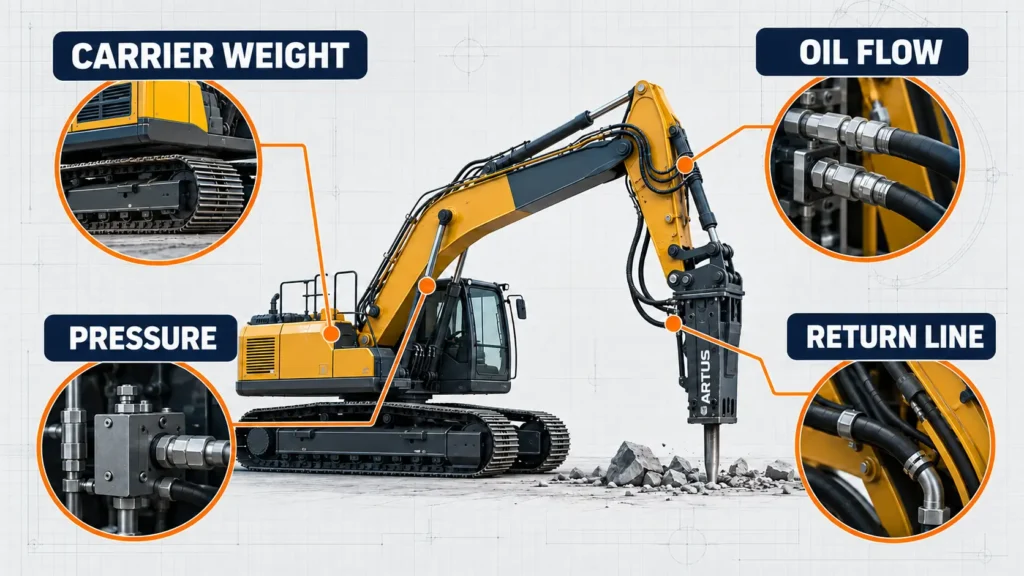
Too little flow can produce slow, weak operation. Too much flow may overspeed the breaker and raise oil temperature, accelerating seal and component wear. Pressure alone does not compensate for incorrect flow, and a machine’s maximum pump output is not necessarily the flow available at the auxiliary circuit.
The most reliable approach is to have a qualified hydraulic technician test the circuit under realistic operating conditions. Confirm the flow, pressure, relief setting, and return pressure at the attachment connection. Check hose diameter, couplings, filters, return routing, and whether the carrier needs a direct-to-tank return or additional cooling.
Hot climates, long shifts, and continuous quarry work place greater demand on the cooling system. Review the permitted hydraulic oil type and viscosity for both the carrier and breaker. If readings fall outside the breaker specification, change the model or correct the carrier setup before work begins.
ARTUS publishes oil-flow and working-pressure ranges on its individual product pages, but those tables are a starting point. Final hydraulic breaker selection should always be confirmed against the exact excavator model, serial configuration, installed lines, and job conditions.
4. Hydraulic Breaker Selection: Balance Tool Size and Impact
Buyers often compare only impact energy. That can be misleading because published energy values may be measured or classified differently across manufacturers. Hydraulic breaker selection is stronger when tool diameter, impact frequency, carrier compatibility, and real application are assessed together.
Tool diameter is a useful indicator of breaker class and the size of the contact area. Larger tools can handle heavier applications, but they also require a suitable carrier and hydraulic supply. A larger tool does not automatically mean faster breaking on thin concrete or small rock.
Impact behavior should match the material:
- Higher-frequency, lighter blows can be effective on thinner concrete, asphalt, and smaller fragmented material.
- Lower-frequency, heavier blows may suit large, hard, or massive rock when the carrier and breaker are properly matched.
- Reinforced concrete may require a combination of controlled cracking, correct tool placement, and separate processing of exposed steel.
Productivity is the amount of acceptable material processed in a given time, not the sound of the hammer or the size printed on its housing. A well-matched unit often outperforms an oversized attachment because it stays stable, maintains correct hydraulic conditions, and lets the operator position the tool precisely.
Ask the supplier to explain why a recommended tool diameter and impact range fit the application. A useful proposal should connect the specification to the carrier and work—not simply present a larger model as an upgrade.
5. Hydraulic Breaker Selection: Choose the Right Housing Type
Housing and mounting geometry influence noise, visibility, access for inspection, protection from debris, and working angle. This part of hydraulic breaker selection should be based on the site rather than appearance.
| Breaker type | Practical strengths | Best-fit applications | ARTUS product page |
|---|---|---|---|
| Box type | Enclosed housing, reduced external noise and vibration, added protection from dust and debris | Urban demolition, road work, tunnels, dusty sites, noise-sensitive projects | Máy cắt thủy lực kiểu hộp |
| Side type | Open access to the chisel, bushings, and grease points; relatively simple daily inspection | Secondary breaking, general demolition, trenching, fleets that prioritize service access | Máy cắt thủy lực kiểu hai bên |
| Tower type | Higher mounting geometry, wide working range, open access, strong vertical positioning | Primary rock breaking, high-reach demolition, tunneling, uneven or specialized work | Cơ cấu cắt thủy lực kiểu tháp |
Box Type for Noise and Component Protection
A box housing encloses the breaker body and uses internal damping elements. It is a practical option when noise, debris exposure, or vibration transfer is a major concern. ARTUS lists its box line for 5–50 ton excavator classes, subject to model-specific hydraulic matching.
Noise control is not just a comfort issue. Construction noise can require engineering controls, hearing protection, and a formal conservation program depending on exposure. Buyers operating in regulated or sensitive areas should review the applicable rules; the OSHA construction noise resources provide a useful starting point for U.S. projects.
Side Type for Access and Straightforward Maintenance
A side type uses an open-frame arrangement that leaves important inspection points visible. It can help maintenance teams check wear areas and reach grease points without removing an outer box. ARTUS publishes side type options spanning 0.5–120 ton carrier classes, with the final fit determined by the specific model and hydraulic data.
Tower Type for Reach and Vertical Work
A tower type mounts higher on the excavator arm and can provide a broad working angle. ARTUS positions this design for primary rock breaking, high-rise demolition, trenching, tunneling, and some specialized working directions. Its published line covers 0.8–40 ton excavators, again requiring model-level confirmation.
No body style is best for every project. Hydraulic breaker selection should weigh noise limits, exposure to dust and flying debris, inspection access, target direction, carrier geometry, and the crew’s maintenance routine.
6. Hydraulic Breaker Selection: Choose the Correct Working Tool
The working tool transfers each piston blow into the material. Choosing it after the breaker body has been selected is a common mistake. Tool choice belongs inside the hydraulic breaker selection process because it affects penetration, crack direction, wear, and control.
Common tool profiles include:
- Moil point: concentrates force into a small area. It is commonly used to start cracks in concrete or rock and for general breaking.
- Wedge or flat chisel: creates a line of force. It can help split layered material, cut asphalt, or direct a crack when orientation is controlled.
- Blunt tool: transfers energy across a broader face. It can suit secondary breaking of already fractured, blocky rock.
Names and approved uses vary by manufacturer, so follow the tool chart supplied with the breaker. The material’s structure, not just its nominal hardness, should guide the final choice.
Also confirm tool diameter, length, retention system, bushing limits, and availability. A nonstandard tool may appear attractive until replacement lead time stops the machine. For a mixed fleet, standardizing selected tool sizes can simplify stock, but never substitute a tool that the manufacturer has not approved.
Correct operation protects the tool. Keep the tool square to the surface unless the manufacturer allows another angle. Avoid side loading, prying, lifting, or using excavator swing force to move material. Reposition when the target is not fracturing instead of holding the breaker in one place indefinitely.
7. Hydraulic Breaker Selection: Confirm Mounting and Hoses
A technically suitable breaker can still fail to install if the bracket dimensions or couplings are wrong. Hydraulic breaker selection is not complete until the physical and hydraulic interfaces are documented.
Collect these mounting details:
- Excavator make, model, year, and serial configuration
- Arm-end width
- Pin diameter
- Pin-center distance
- Direct-pin bracket or quick-hitch type
- Required hose size, length, routing, and end fittings
- Auxiliary line location and flow direction
- Electrical connection, if an automatic lubrication or control system is used
If the fleet changes attachments frequently, a properly matched excavator quick hitch can reduce changeover time. Its extra weight and offset must still be included in stability and reach calculations.
Attachment retention is safety-critical. The UK Health and Safety Executive advises users to ensure that quick hitches are properly selected, managed, checked, and maintained; its excavator safety overview also stresses training, exclusion zones, and daily inspection. Follow local law, the carrier manual, the hitch manual, and site procedures.
Before production work, complete the manufacturer’s installation and engagement checks. Inspect hoses at full boom movement to confirm that they do not stretch, rub, kink, or contact the tool. Verify the locking system from the prescribed position and keep people outside the attachment operating area.
8. Hydraulic Breaker Selection: Evaluate Parts and Support
Purchase price is visible; downtime often is not. Hydraulic breaker selection should include the maintenance system that will keep the attachment working after the first shipment.
Ask the supplier for the required schedule and procedure for:
- Tool lubrication and approved grease
- Tool and bushing wear measurement
- Retaining-pin inspection
- Through-bolt or side-bolt checks
- Hose and coupling inspection
- Nitrogen checks, if applicable to the design
- Hydraulic oil and filter requirements
- Seal service and planned overhaul
- Storage and contamination prevention
Then check which parts are stocked and where they ship from. High-use items may include tools, tool pins, bushings, seal kits, diaphragms, pistons, front heads, bolts, and hoses. Request part numbers for the proposed model and identify which items the site or distributor should hold locally.
Service information matters as much as inventory. Confirm that the supplier can provide an operation manual, parts book, installation drawing, hydraulic requirements, wear limits, troubleshooting support, and a clear warranty process. Ask who reviews photos, videos, pressure readings, or failure reports and what information is required for a technical response.
ARTUS states that it manufactures hydraulic breakers and supplies wear parts for its range. Buyers can review the company’s manufacturing and OEM background and should request a model-specific parts and service proposal with the quotation.
9. Hydraulic Breaker Selection: Compare Total Cost and RFQs
The lowest unit price is not always the lowest operating cost. A practical hydraulic breaker selection compares the cost of putting the attachment into service and keeping it productive.
Include these items in the commercial comparison:
- Breaker, housing, bracket, and selected working tool
- Pins, hoses, couplings, and installation kit
- Quick hitch or adapter requirements
- Freight, insurance, duties, and local delivery
- Installation, flow testing, and carrier setup
- Initial spare-parts package
- Routine grease, tools, and filters
- Planned wear parts and overhaul labor
- Expected downtime and parts lead time
- Warranty scope and technical support
A cheaper attachment can become expensive when the bracket needs rework, hoses are missing, or a common seal kit takes weeks to arrive. Compare quotations on the same delivered scope, not only the breaker body
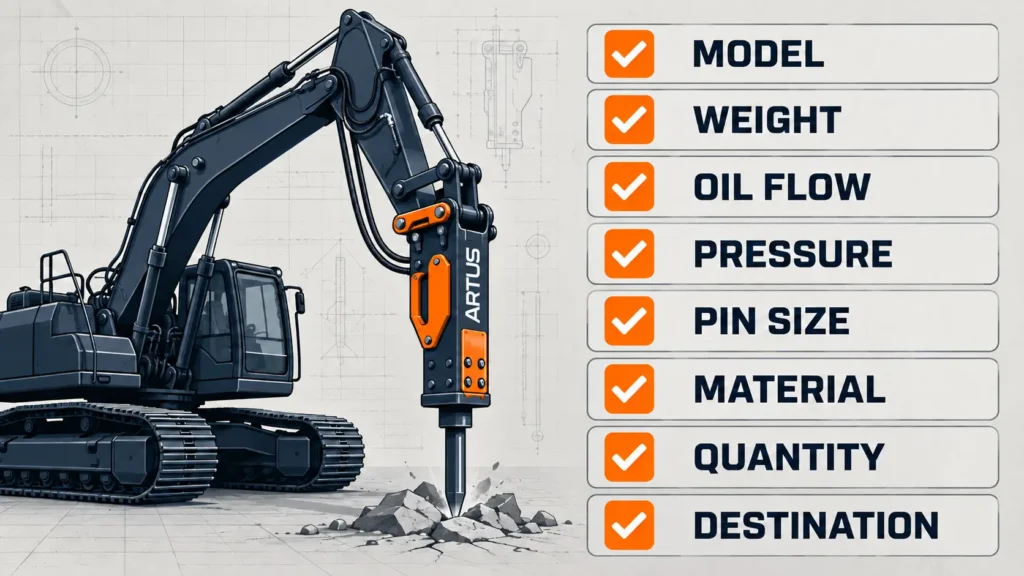
Hydraulic Breaker Selection RFQ Checklist
Send the following information to obtain a useful recommendation:
| Information | What to provide |
|---|---|
| Nhà cung cấp dịch vụ vận tải | Make, model, year, serial configuration, operating weight |
| Front equipment | Standard, long-reach, or other boom and arm; counterweight details |
| Hydraulic circuit | Measured or documented auxiliary flow, pressure, relief setting, return arrangement |
| Mounting | Pin diameter, pin centers, arm-end width, bracket or coupler type |
| Application | Material, target size or thickness, primary or secondary breaking, working direction |
| Duty | Hours per day, days per week, ambient temperature, dust and moisture conditions |
| Site limits | Noise restrictions, access limits, tunnel, underwater, or other special conditions |
| Tool | Preferred tool profile or request for a recommendation |
| Commercial needs | Quantity, destination, required delivery date, OEM color or branding, spare-parts package |
Photos of the carrier plate, arm end, auxiliary lines, existing coupler, and typical material can prevent misunderstandings. For unusual applications, include a short video and a drawing of the working envelope.
Common Hydraulic Breaker Selection Mistakes
Use the same hydraulic breaker selection criteria for every supplier, and avoid these errors during evaluation:
Choosing by Excavator Tonnage Alone
Tonnage is a filter, not a final approval. Confirm lift capacity, installed weight, hydraulic supply, geometry, and application.
Selecting the Largest Model in the Range
The largest compatible-looking attachment may reduce stability or exceed the hydraulic circuit. Choose the model that creates the best productive system.
Ignoring Return Pressure and Heat
Flow and pressure tables do not tell the whole story. Return routing, back pressure, oil condition, ambient temperature, and cooling capacity can determine whether a breaker runs reliably.
Treating Every Rock or Concrete Job as the Same
Material structure, reinforcement, target size, and working direction change the correct tool and operating method. A detailed application brief improves hydraulic breaker selection.
Comparing Incomplete Prices
A breaker without the right bracket, tool, hoses, couplings, pins, or spares is not ready to work. Normalize the delivered scope before comparing suppliers.
Forgetting Local Parts Stock
Wear is normal. The commercial plan should state which parts will be held locally, their part numbers, lead times, and reorder process.
A Simple Final Approval Sequence
For a consistent hydraulic breaker selection decision, use this order before issuing a purchase order:
- Define the material, task, duty cycle, environment, and production goal.
- Verify the actual carrier weight, lift capacity, geometry, and stability.
- Measure or confirm auxiliary flow, pressure, relief, return pressure, and cooling.
- Shortlist only breakers within the approved carrier and hydraulic ranges.
- Choose the housing and tool for the application.
- Confirm bracket, pin, coupler, hose, and fitting dimensions.
- Review maintenance requirements, local spares, documentation, and warranty.
- Compare total delivered and operating cost.
- Obtain written model approval and complete commissioning checks.
This sequence makes hydraulic breaker selection traceable. It also gives the supplier, installer, operator, and maintenance team the same technical baseline.
Why Buyers Ask ARTUS to Match the Complete System
ARTUS manufactures box, side, and tower type breakers for applications ranging from compact construction work to demolition and quarrying. The company publishes model-level oil flow, pressure, working frequency, tool diameter, weight, and carrier-class data on its product pages.
The engineering team can review excavator details, mounting dimensions, application, and destination before recommending a configuration. OEM branding, selected colors, mounting solutions, and spare-parts packages are available for qualified orders.
The goal is not to sell the largest breaker. It is to match a breaker that the carrier can operate safely and productively, then support it with the parts and information required for the job.
For a model recommendation, send the RFQ checklist above through the ARTUS contact page. Include photos of the excavator plate, arm end, hydraulic connections, and material whenever possible.
Frequently Asked Questions
How do I choose the right hydraulic breaker for an excavator?
Start the hydraulic breaker selection process with the excavator’s actual operating configuration and the job. Confirm the approved carrier range, total installed attachment weight, lift capacity, auxiliary oil flow, working pressure, relief setting, return pressure, and cooling. Then select the housing, tool, bracket, and service package for the material and duty cycle. Final approval should come from the carrier and breaker specifications, not tonnage alone.
Can I choose a breaker using only excavator tonnage?
No. Tonnage creates an initial shortlist, but machines in the same class can have different hydraulic circuits, boom geometry, counterweights, and lift capacity. Hydraulic breaker selection must also include the actual attachment weight, oil flow, pressure, return requirements, mounting dimensions, and application.
What happens if hydraulic flow is too high?
Flow above the breaker’s approved range can make it cycle too fast, generate heat, and accelerate wear or damage. The carrier circuit should be tested and adjusted by a qualified technician according to both manufacturers’ instructions. Never assume that the machine’s display setting is accurate without commissioning checks.
Is a heavier hydraulic breaker always more powerful?
Not in a useful sense. A heavier unit may destabilize the carrier or operate poorly if the hydraulic supply is wrong. Productivity depends on a stable carrier, correct flow and pressure, suitable impact behavior, proper tool placement, and a tool matched to the material.
Which housing is best for urban demolition?
A box type is often preferred where noise reduction, vibration damping, and protection from debris are priorities. However, the final choice must still match the excavator, material, working space, local noise requirements, and maintenance plan.
Which breaker type is easiest to inspect?
An open-frame side type provides direct visual access to areas such as the tool, bushing, and grease points. A tower type also uses an open layout in the ARTUS range. Ease of inspection should be balanced against noise control, debris protection, working angle, and application.
What information does a manufacturer need for hydraulic breaker selection?
Provide the excavator make and model, operating configuration, auxiliary flow and pressure, relief and return details, pin dimensions or coupler type, material, target size, duty cycle, working direction, climate, destination, and required delivery date. Photos and videos improve the recommendation.
What spare parts should I order with a new breaker?
The answer depends on the model and expected use. Ask for a commissioning kit and a recommended package for the first service period. Common items may include a working tool, tool pins, bushings, seal kits, hoses, and approved grease. Use only parts and service limits specified for the exact model.
Make the Selection Before You Compare the Price
Hydraulic breaker selection is a technical matching process, not a catalog shortcut. Define the job, verify the carrier, measure the hydraulic circuit, select the correct body and tool, confirm every interface, and plan the parts supply. Those steps protect the excavator and give the operator a better chance of meeting production targets.
If you are comparing models now, send ARTUS your excavator data and application brief. The team can review the complete setup, support the final hydraulic breaker selection, and prepare a configuration, mounting plan, spare-parts recommendation, and quotation for your project.